
Every year, air pollution reports make headlines, but they often miss important details. For example, a recent article by Helen Horton in The Guardian might leave readers thinking that all wood-burning stoves are bad for air quality. This is due to how the media sometimes oversimplifies the data, grouping all wood stoves together without distinguishing between different types.
The Problem with Simplified Labels
The term “wood-burning stoves” is too broad and can be misleading. It combines various types of stoves and fuels into one category. According to the Stove Industry Association (SIA), recent data from the National Atmospheric Emissions Inventory (NAEI) shows that, despite a record year for stove sales in 2022, emissions from domestic wood burning actually fell by 2.7%. This important detail often gets overlooked in the media.
Breaking Down the Data
The NAEI data separates “wood-burning stoves” into specific categories, such as:
- Basic Domestic Closed Stoves
- Ecodesign Domestic Closed Stoves
- Upgraded Domestic Closed Stoves
- Standard Domestic Fireplaces
Each of these categories is further divided by fuel type, including different kinds of wood and other materials.
The Impact of Modern Stoves
Modern Ecodesign stoves, which are designed to be more efficient, have a much lower impact on air quality compared to older models. In 2022, open fires were responsible for 13.3% of the UK’s PM2.5 emissions, while Ecodesign stoves accounted for only 1.8%. When burning dry wood, Ecodesign stoves contributed just 0.3% of emissions.
Putting It in Perspective
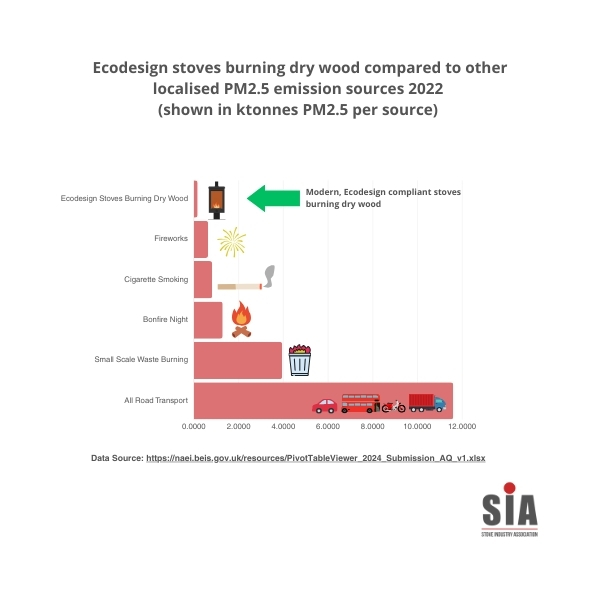
For comparison, the NAEI data reveals:
- Road transport produces 66.7 times more PM2.5 emissions than Ecodesign stoves burning dry wood.
- Cigarette smoking causes 4.7 times the emissions.
- Small-scale waste burning results in 22.7 times more emissions.
- Bonfire night emissions are 7.4 times higher.
Making Smart Choices
To reduce your environmental impact while using a wood-burning stove, consider these tips:
1. Choose an Ecodesign Stove: Opt for a stove that meets Ecodesign standards and is certified by clearSkies. In Smoke Control Areas, make sure it’s Defra exempt.
2. Get Expert Advice: Consult a local SIA Retail Group member for recommendations on the best stove for your home.
3. Proper Installation: Have your stove installed by a qualified professional, such as one registered with HETAS or OFTEC.
4. Use Quality Fuel: Burn wood logs with the Ready to Burn logo, which indicates they are properly seasoned. Avoid burning treated wood or waste.
5. Regular Maintenance: Service your stove and sweep your chimney at least once a year.
By following these guidelines, you can enjoy the warmth of your wood-burning stove while minimising its impact on air quality.
For more information, you can read the full report from the Stove Industry Alliance here.
 Living Fires